The Real Reason Your Rep Network Isn't Performing
For years, when sales lag in a rep-driven model, the response has been almost automatic:
“We need better reps.”
It’s an easy conclusion to reach. It’s also often the wrong one. Because in many cases, rep performance isn’t a people problem, it’s a systems problem.
And until manufacturers are willing to look inward at how they equip, support, and engage their reps, the cycle continues. New reps come in. Expectations stay the same. Results don’t change.
If independent reps are truly an extension of your sales force, and most manufacturers will tell you they are, then the real question becomes: Are you actually treating them that way?
The Misdiagnosis
I’ve seen this play out over and over again. A manufacturer feels like their reps aren’t pushing the line. They’re not getting enough mindshare. Opportunities seem to go elsewhere.
So they switch reps.
And for a short period of time, things improve. There’s new energy. New conversations. Maybe even a bump in sales.
But eventually… things level off.
Not because the reps changed. Because the system didn’t.
Here’s the reality: independent reps are managing multiple lines, multiple priorities, and multiple demands on their time. They naturally gravitate toward the manufacturers who make it easiest to win.
Not just easiest to sell, but easiest to understand, position, and deliver.
Reps don’t fail in a vacuum. They respond to the environment you create.

How Are You Actually Equipping Your Reps for Success?
Most manufacturers will say they “support” their reps. But when you look closer, that support is often reactive, inconsistent, or unclear. Think about it from the rep’s perspective.
Can they clearly articulate where you win, and where you don’t? Do they have a simple, confident way to position your line in a conversation? Or are they piecing it together from product sheets, past conversations, and guesswork?
If a rep can’t confidently explain your value in 30 seconds, that’s not a rep issue. That’s an enablement issue.
Equipping reps for success isn’t about giving them more information. It’s about giving them clarity.
The Training Gap
This is where many manufacturers fall short. They mistake information for enablement. A product launch presentation. A PDF. Maybe a webinar. And then… nothing.
But reps don’t need more information. They need capability.
Especially in a world where:
Products are more complex
Buyers are more informed
Competition is more aggressive
Training can’t be a one-time event. It has to be a system. Ongoing. Reinforced. Practical.
And most importantly, built for how reps actually learn, on the go, in the field, in real conversations.
Content Accessibility: The Hidden Friction
Even when manufacturers create good content, there’s another problem: Reps can’t find it when they need it. It’s buried in email threads. Stored across multiple platforms. Outdated. Overly complex. Or too generic to be useful.
Now put yourself in the rep’s shoes again.
You’re in front of a dealer or designer. A question comes up. You need something fast. Do you know exactly where to go? Or do you think, “I’ll just follow up later”… and risk losing momentum?
Content only works if it’s accessible in the moment. If it takes more than a few clicks, or a call to your team, you’ve already created friction.
Field Support vs Field Expectations
This is where the gap becomes more visible. Manufacturers have expectations for their reps:
Drive pipeline
Build relationships
Grow market share
Show up consistently
All fair expectations. But what does support look like on the other side?
Are you present in key markets? Do you show up for important conversations? Are you actively helping open doors and build credibility? Or are reps expected to carry the weight on their own?
You can’t expect ownership from your reps if you don’t show up like a partner.
What Makes a Line Easy to Sell?
Here’s something every rep understands intuitively: Some lines are just easier to sell than others. Not because they’re simpler. But because they remove uncertainty.
Easy-to-sell lines typically have:
Clear positioning
Straightforward pricing
Reliable lead times
Confidence in execution
A team that responds quickly and owns the outcome
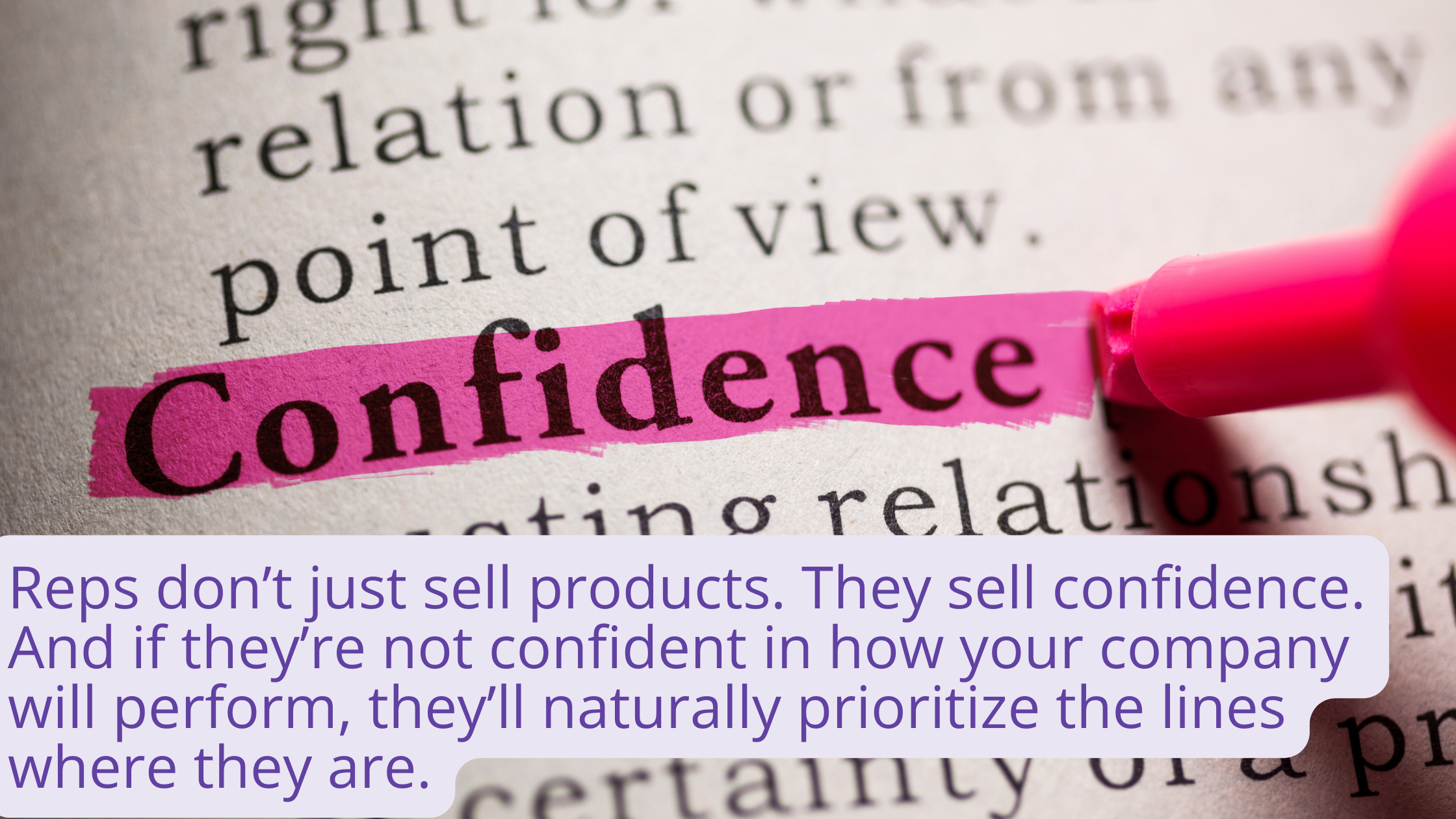
Reps don’t just sell products. They sell confidence. And if they’re not confident in how your company will perform, they’ll naturally prioritize the lines where they are.
The Friction Gap
This is the part that doesn’t get talked about enough. Manufacturers say they want a partnership. But their systems often create friction.
Slow response times.
Complicated quoting.
Inconsistent communication.
Lack of ownership when something goes wrong.
None of these feels like a big issue on its own. But together, they add up.
And over time, reps start to make decisions, consciously or not, about where to invest their energy. You can’t ask for loyalty while making it hard to do business.
A Better Way Forward
This isn’t about overhauling everything overnight. It starts with a shift in perspective. Instead of asking, “Why aren’t our reps performing?” Ask, “What system have we built around them?”
The manufacturers who do this will win in a rep-driven model, aren’t the ones with the biggest line or the most markets. They’re the ones who are intentional about how they enable their reps to succeed.
That means:
Treating reps like a true extension of your team
Building structured, ongoing enablement, not one-time training
Making content easy to access and use in real time
Showing up in the field as a partner, not just a supplier
Continuously removing friction from the experience
And most importantly, creating feedback loops with your reps, so you can see what’s actually working and what’s not.
From Insights to Action: Practical Ways to Enable Your Reps
At this point, the question isn’t whether systems matter. It’s what you’re going to do about them.
The good news is, you don’t need a massive overhaul to start making meaningful progress. In fact, some of the most effective changes are also the most practical.
Start with access.
Reps don’t need more information, they need the right information, in the right format, at the right time.
This is where tools like AI and new content formats can make a real difference.
Imagine this:
A rep can ask a simple question and instantly get a clear, accurate answer about your product, pricing, or positioning
New reps joining a group can get up to speed in days, not months
Your best sales conversations are captured and turned into repeatable training
That’s not a future state. That’s available right now.
Some practical ways to start:
Create a simple, structured onboarding path. Not a one-time presentation, but a clear, repeatable way for any new rep to understand your line, your positioning, and where you win.
Leverage AI as a knowledge assistant
Turn your product information, pricing guidelines, and FAQs into something searchable and conversational. Make it easy for reps to get answers without having to chase your team.
Build a private podcast for rep enablement
Short, focused episodes that reps can listen to on the go:
Product overviews
How to position against competitors
Real-world selling scenarios
Common mistakes to avoid
This meets reps where they already are, in their car, between meetings, in the flow of their day.
Simplify and centralize your content
If your materials live in five different places, they don’t really exist. Create one clear, easy-to-navigate hub with only what’s relevant and up to date.
Audit your friction points
Look at your quoting process. Your response times. Your internal handoffs. Where are reps losing momentum? Start there.
Create a feedback loop with your reps
Ask them directly:
What’s hard about selling our line?
Where do you get stuck?
What would make this easier?
Then actually act on what you hear.
None of this is about perfection.
It’s about intention.
Because when you make it easier for reps to understand, engage, and sell your line, you’re not just improving performance.
You’re building trust. And that’s what turns a vendor relationship into a true partnership.
Independent reps can be one of the most powerful growth engines a manufacturer has. But only if the system around them is built to support that growth. Because in the end, rep performance isn’t just about who you hire. It’s about how you show up. And the system you build around them.
Want to learn more on this topic? Join us for a free webinar May 27th at 11 EST:
https://zoom.us/meeting/register/z0EO3QauQvmnYdibao0HBA
